
How to Split Bills Fairly (With Real Examples) — Free Calculator, No Signup
Someone always ends up paying more than they should. Whether it's a group dinner where one person had a salad and someone else ordered steak and cocktails, or three housemates trying to divide a utility bill, the maths gets awkward — and so does the conversation.
This guide covers every common bill-splitting scenario, with a free calculator that handles the maths instantly.
How do you split a bill evenly?
Add up the total cost including tax and tip. Divide by the number of people. That's it for an even split. If you want to split by what each person ordered, add each person's items separately, then divide their subtotal by the group total to get their percentage share.
Why bill splitting gets complicated
An even split is simple. The real friction starts the moment the group isn't equal.
Four friends at dinner. Two had mains only. One had two rounds of drinks. One had the tasting menu. Splitting evenly means the salad person subsidises the steak person — and everyone knows it, even if nobody says it out loud.
Then there's tip. Do you tip on the pre-tax amount or post-tax? Do you tip 10% or 15%? If someone's not drinking, do they still chip in on the bottle of wine? These aren't hypotheticals. They're the exact questions that cause table silence.
The clean answer: use a calculator and remove the negotiation entirely.
The 3 ways to split a bill
1. Split evenly
Everyone pays the same amount regardless of what they ordered. Works best for:
- Close friends where it usually balances out over time
- Groups where items are roughly similar in price
- Situations where fairness matters less than simplicity
The maths: Total ÷ number of people = each person's share.
Dinner total with tip: £144. Four people. Each person pays £36.
2. Split by what you ordered (itemised)
Each person pays for their own items. Best for:
- Groups where spending varies significantly
- Work lunches where people need to expense their own meals
- Anyone on a budget dining with people who aren't
The maths: Add your items. Divide your subtotal by the pre-tip total to get your percentage. Multiply that percentage by the final total including tip.
Example: You spent £22 of a £100 pre-tip total. You owe 22% of the final bill. If tip brings the total to £115, you pay £25.30.
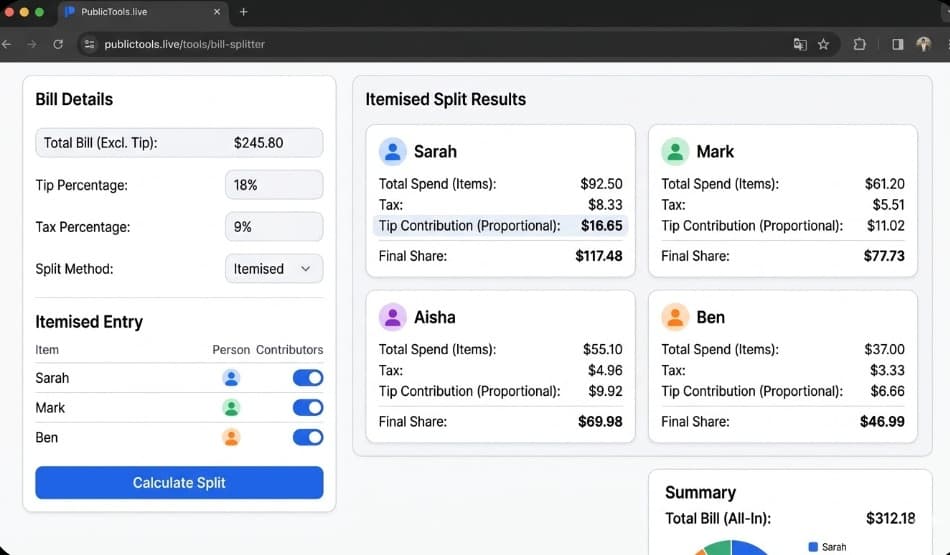
3. Split by percentage or custom amount
Someone earns more and wants to cover more. Or someone didn't eat much and wants to pay less. You agree on custom percentages or fixed amounts per person, and the remainder is covered by whoever's picking up the rest.
Works for: couples splitting utilities, housemates with different income levels, or anyone who's just agreed to cover a set amount.
How to split a bill — step by step
Step 1: Get the total
Include tax. Don't forget any service charges the venue added automatically — check the bottom of the bill. A lot of restaurants add 12.5% service and then people tip on top of that.
Step 2: Decide on the split method
Before you open the calculator, agree on which method. Even? Itemised? Custom? Having this conversation before you start the maths avoids the back-and-forth after.
Step 3: Decide on the tip
Standard is 10–20% depending on where you are. In the US, 18–20% is the norm. In the UK, 10–12.5% is typical — though many venues have already added it. In most of Europe, tipping is optional and often just rounding up. Check the bill before you add a tip on top of a tip.

Step 4: Enter the numbers
Paste the total into the calculator below, select your split method, and set the tip. Done.
Step 5: Share the breakdown
Screenshot the result or send the link. No more "I think it was about £30 each?" — everyone sees the same number.
Free Tool
Bill Splitter
Split any bill fairly among friends with tip.
Real example: group dinner, mixed orders
Five people. Dinner in London. Here's what they ordered:
| Person | Food | Drinks | Subtotal |
|---|---|---|---|
| Alice | £18 | £12 | £30 |
| Ben | £24 | £0 | £24 |
| Carla | £16 | £28 | £44 |
| Dan | £22 | £8 | £30 |
| Eve | £14 | £8 | £22 |
| Total | £94 | £56 | £150 |
Even split at 15% tip: £(150 × 1.15) ÷ 5 = £34.50 each
Itemised split at 15% tip: Carla pays 44/150 × 172.50 = £50.60. Eve pays 22/150 × 172.50 = £25.30.
That's a £25 difference between the two methods — which explains why Carla probably votes for even splits and Eve would prefer itemised.

Common mistakes to avoid
Adding tip twice. The receipt already has a 12.5% service charge. You add 15% tip on top. Now you've tipped 27.5% and nobody noticed. Always check whether service is already included before tipping.
Forgetting tax when calculating percentages. If you're doing an itemised split, use the final post-tax total — not the subtotal — as your denominator. Otherwise your percentages won't add up to 100%.
Splitting drinks evenly when one person isn't drinking. Someone's driving or not drinking for whatever reason. They shouldn't pay for the three rounds of wine the rest of the table had. Either exclude drinks from the even split or go itemised on drinks specifically.
Not agreeing on the method before you calculate. The disagreement never happens in the abstract. It happens when one person pulls out a calculator and the others disagree with the result. Settle the method first.
Rounding everyone down. Five people, £101 bill, everyone rounds to £20 — now the bill is £100 and someone's covering the £1 shortfall. Whoever collects the cash ends up covering it. The calculator handles this properly.
Splitting bills fairly isn't about being petty — it's about removing an awkward conversation from an otherwise good time. The calculator handles the maths. You just have to agree on the method.